
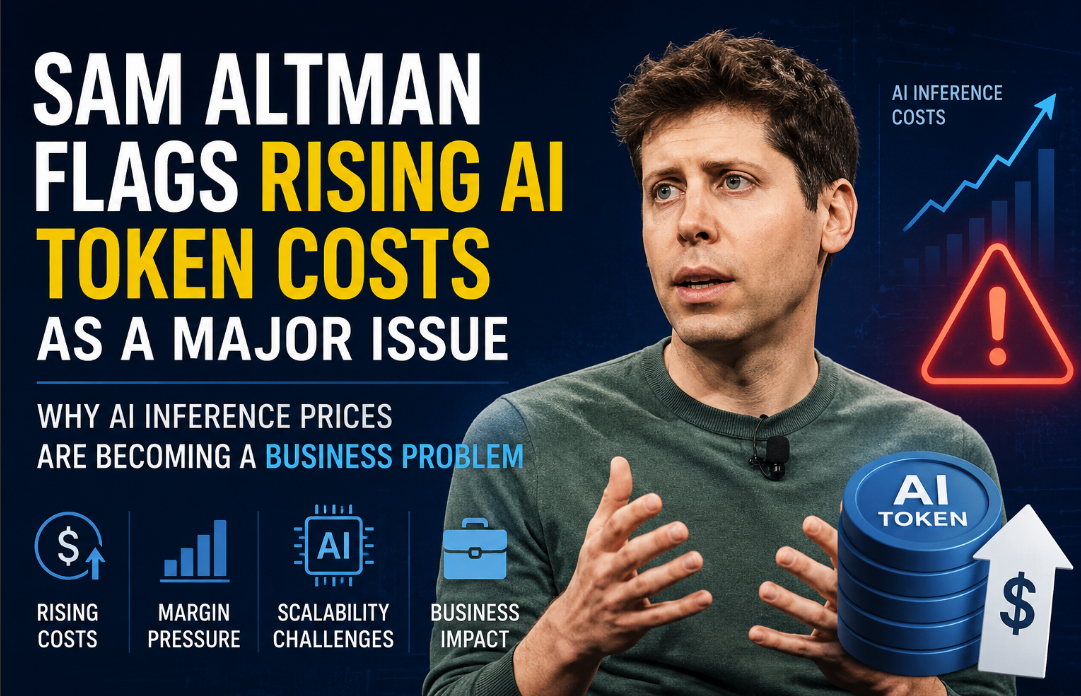
Sam Altman Says Rising AI Token Costs Are a Huge Issue
OpenAI CEO Sam Altman has highlighted one of the most pressing challenges in the current AI boom: the rising cost of AI tokens. In simple terms, every time a user sends a prompt or receives a response from a large language model, tokens are consumed. As AI usage grows across apps, enterprises, and consumer products, the cost of processing those tokens is becoming a significant business concern.
Altman’s comment points to a deeper problem in the AI industry. While AI tools are becoming more powerful and widely adopted, the economics of running them at scale are still fragile. For companies building AI products, token-based pricing can quickly turn into a major expense, especially when millions of requests are processed daily.
“Rising AI token cost is a huge issue” is not just a technical observation. It is a warning sign for the entire AI ecosystem, from startups to large enterprises.
What Are AI Tokens and Why Do They Cost More at Scale?
AI models such as ChatGPT, Gemini, Claude, and others process text in units called tokens. A token can be a word, part of a word, or punctuation. The more tokens a model reads and generates, the more compute it uses. That means longer prompts, longer answers, and more frequent usage all increase cost.
For example, a customer support bot that handles 100,000 conversations per day may look inexpensive at first. But if each conversation includes long context, document uploads, and detailed answers, the token usage can skyrocket. At enterprise scale, even small increases in per-token pricing can translate into substantial monthly bills.
Why Sam Altman’s Comment Matters for the AI Industry
Altman’s remarks matter because OpenAI is one of the biggest players in the market. If even leading AI companies are concerned about rising token costs, it signals that the economics of AI deployment are under pressure.
The AI industry is currently balancing three major forces:
- Growing user demand for AI-powered assistants and automation tools
- Rising compute requirements for advanced reasoning and multimodal models
- Pricing pressure as businesses demand cheaper and faster access
This creates a challenging environment where innovation must continue, but costs must also fall if AI is to remain affordable for the mass market.
Real-World Examples of Rising AI Token Costs
1. AI Customer Support Platforms
A startup using an AI chatbot to answer customer queries may begin with a manageable bill. But once usage scales across multiple regions and languages, token consumption can multiply. If the bot also summarizes tickets, checks knowledge bases, and drafts responses, the cost can increase dramatically.
2. AI Coding Assistants
Developers using AI coding tools often paste entire files, project contexts, and long debugging logs into the model. This improves accuracy but consumes a large number of tokens. A company with hundreds of engineers using AI coding support daily may spend thousands of dollars every month just on inference costs.
3. AI Search and Research Tools
AI-powered search products that generate summaries, compare documents, or answer complex questions often require very large context windows. In practical terms, the more sources the model reads, the more expensive each query becomes. This can become especially costly for media, legal, and finance applications.
Statistics That Show the Scale of the AI Cost Challenge
The rising cost of AI token usage is closely linked to the explosive growth of the AI market. According to industry estimates, the global generative AI market is projected to reach hundreds of billions of dollars over the next few years, driven by enterprise adoption and consumer demand. At the same time, AI inference workloads are expected to outpace training workloads as more users interact with deployed models every day.
- AI token usage grows as applications move from occasional use to always-on workflows.
- Inference, not just training, is becoming the dominant cost center for AI companies.
- Enterprises are increasingly asking for predictable pricing instead of variable token-based billing.
In many cases, the cost of serving an AI model is less about the raw model and more about how much context, reasoning, and output the user expects. That is why long-form AI assistants, agents, and multimodal systems often cost far more than simple chatbots.
Why AI Token Costs Are Rising
There are several reasons token costs are becoming a bigger concern:
- More complex models: Newer AI systems are larger and more capable, requiring more compute per request.
- Longer context windows: Users now expect models to remember large amounts of information, which increases token consumption.
- Higher usage volume: Millions of users and businesses are adopting AI tools every day.
- Multimodal inputs: Images, audio, and documents add to processing complexity.
- Agent workflows: AI agents may make multiple model calls for a single task, multiplying costs.
As these features become standard, businesses can no longer assume AI usage will remain cheap. The token economy is becoming a central issue in product design and financial planning.
How Businesses Are Responding to the Cost Problem
Companies are already taking steps to reduce AI spending and improve efficiency. Some are switching to smaller models for routine tasks and reserving larger models for high-value requests. Others are optimizing prompts, shortening context, and caching responses to reduce unnecessary token use.
For example, a fintech company might use a lightweight model to classify customer queries and only send complex cases to a premium reasoning model. Similarly, an e-commerce platform may rely on a cheaper model for product recommendations while using a more advanced one for dispute resolution or legal content review.
Common Cost-Control Strategies
- Prompt optimization: Reducing unnecessary words and context in requests
- Model routing: Sending simple tasks to cheaper models
- Caching: Reusing previous responses when possible
- Summarization: Compressing long histories into shorter memory chunks
- Usage limits: Setting caps on prompts, outputs, and agent actions
What This Means for AI Users
For everyday users, rising token costs may not always be visible directly. But they can affect product pricing, feature availability, and usage limits. Free tiers may become more restrictive, while premium plans may become more common. Businesses may also pass costs to customers through subscription fees or usage-based pricing.
This means the future of AI may depend not only on model quality but also on affordability. If token costs remain high, smaller startups could struggle to compete with larger companies that have the budget to absorb them.
The Bigger Picture: AI Must Become Cheaper to Scale
Altman’s warning highlights a simple truth: for AI to become truly universal, it must become more cost-efficient. The industry needs better chips, smarter model architectures, optimized inference systems, and more efficient deployment methods.
In the next phase of AI growth, the winners may not be only the most intelligent models, but also the most economical ones. As more companies integrate AI into everyday workflows, controlling token costs will be as important as improving accuracy.
The rising AI token cost issue is therefore more than a temporary pricing challenge. It is a structural question about how the AI economy will work at scale.
Key Takeaways
- Sam Altman says rising AI token costs are a major issue in the AI industry.
- Token costs rise as models process longer prompts, more users, and complex tasks.
- Enterprises, startups, and consumer apps are all feeling the pressure.
- Businesses are using model routing, caching, and prompt optimization to cut costs.
- The future of AI depends on making inference cheaper and more scalable.
As AI adoption accelerates, cost efficiency will become one of the most important battlegrounds in the industry. The companies that solve the token cost problem may define the next generation of AI products.
