
Table of Contents
- The Hidden Cost of the AI Revolution
- What is an NPU and Why Does It Matter?
- How NPUs Solve the High Usage Billing Problem
- 1. Elimination of Cloud API Costs
- 2. Reduced Data Egress Fees
- 3. Lower Infrastructure Overheads
- Real-World Examples of NPU Cost-Efficiency
- The Economic Shift: A Strategic Move
- Key Benefits for the Future-Ready Business
- Conclusion: The Path Forward
The Hidden Cost of the AI Revolution
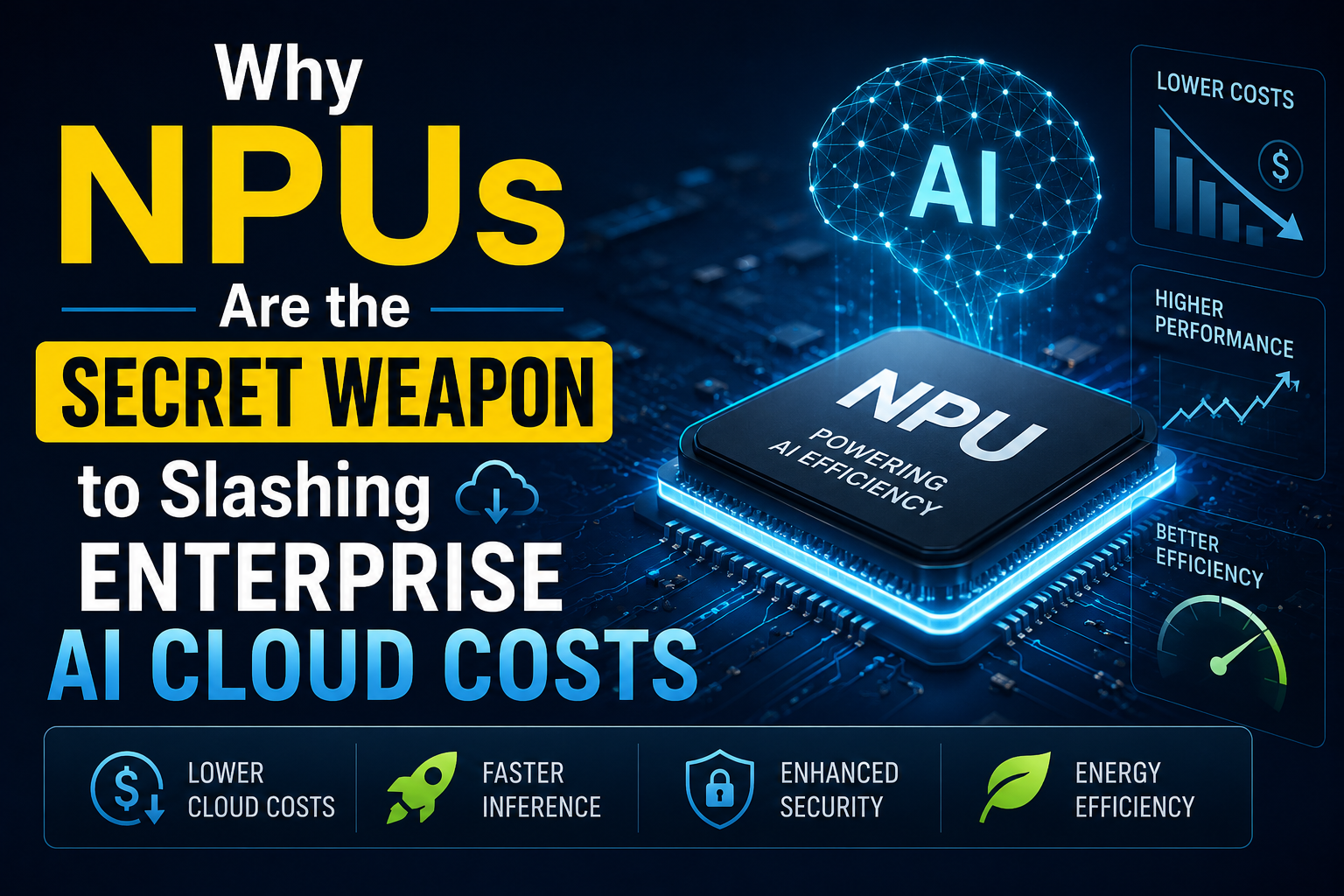
As businesses rush to integrate Artificial Intelligence into their workflows, a silent crisis is emerging: the ballooning cost of cloud-based AI inference. Organizations relying entirely on Large Language Models (LLMs) hosted in the cloud are facing unpredictable usage billing, expensive API tokens, and significant latency issues. Enter the Neural Processing Unit (NPU)—a specialized piece of hardware designed to handle AI tasks locally, effectively decentralizing the compute burden.

What is an NPU and Why Does It Matter?
An NPU is a specialized processor architecture designed specifically to accelerate neural network operations. Unlike a CPU, which is a general-purpose multitasker, or a GPU, which excels at massive parallel graphics rendering, an NPU is optimized for the low-power, high-efficiency matrix mathematics required for AI inference.
By shifting AI processing from the cloud to the device (Edge AI), companies can bypass the per-token pricing models that make enterprise-scale AI implementations prohibitively expensive.
How NPUs Solve the High Usage Billing Problem
The financial impact of moving workloads to the edge is measurable. Here is how NPUs are fundamentally changing the economics of AI:
1. Elimination of Cloud API Costs
Every time a cloud-based AI model processes a request, there is a cost associated with data transfer and token usage. For a company processing millions of customer service queries, these costs can reach tens of thousands of dollars monthly. With an NPU-equipped device, the model runs locally. Once the hardware is purchased, the cost per query effectively drops to near zero.
2. Reduced Data Egress Fees
Cloud providers charge significant fees for moving large datasets between storage and compute instances. By keeping data on-device, organizations avoid these egress fees entirely, securing both their budget and their data privacy.
3. Lower Infrastructure Overheads
Maintaining high-performance cloud server clusters requires constant energy consumption and maintenance. NPUs operate with significantly higher power efficiency. Statistics show that local NPU-based inference consumes up to 80% less power than traditional server-based processing for equivalent tasks, drastically reducing the carbon footprint and operational expense.
Real-World Examples of NPU Cost-Efficiency
- Enterprise Video Conferencing: Platforms that use local NPUs for real-time background blur, noise cancellation, and eye-contact correction avoid the need to stream video data to a cloud server for processing. This saves millions in bandwidth and server-side compute costs annually.
- Local Document Summarization: Legal and financial firms are now using local NPUs to run private LLMs on employee laptops. This allows for sensitive document analysis without paying for third-party cloud API services, while simultaneously ensuring data compliance.
- Automated Predictive Maintenance: In manufacturing, sensors often stream data to the cloud for analysis. By utilizing NPUs at the edge, factories can analyze equipment vibrations in real-time on-site, saving massive cloud storage and compute costs previously spent on processing redundant data.
The Economic Shift: A Strategic Move
The integration of NPUs into personal and enterprise computing marks the end of the 'cloud-everything' era. By reclaiming the 'compute' portion of the AI stack, businesses can achieve a long-term reduction in total cost of ownership (TCO) by an estimated 30-40% over three years.
Key Benefits for the Future-Ready Business
Adopting NPU-powered hardware is no longer just a technical trend; it is a financial imperative. When evaluating your next hardware refresh, consider these advantages:
- Predictable Budgeting: No more surprise spikes in API usage bills.
- Enhanced Data Security: Sensitive information never leaves the local hardware, mitigating the risk of data breaches.
- Operational Independence: AI tools remain functional even during cloud outages or internet connectivity issues.
- Scalability: Deploying AI tools to thousands of employees becomes a one-time hardware investment rather than a recurring subscription-based operational cost.
Conclusion: The Path Forward
The NPU is the catalyst that will make AI sustainable for the masses. By decentralizing intelligence and empowering the local device, companies can finally move past the friction of high usage billing. As AI matures, the winners will be the organizations that successfully leverage local hardware to manage their compute costs, ensuring that AI remains an asset to the bottom line rather than a liability.
